

Apache Kafka 4.2.0 is here
Apache Kafka 4.2.0 was announced on February 17, 2026. This release continues Kafka’s focus on production-grade reliability, operational consistency, and developer ergonomics.
For teams running Kafka in production, this release is less about headline marketing features and more about reducing the operational drag that accumulates in real environments. The improvements in 4.2.0 are concentrated in areas that directly affect reliability, troubleshooting speed, and confidence during upgrades.
Key platform changes in Kafka 4.2.0
1. Share Groups (Kafka Queues) are now production-ready
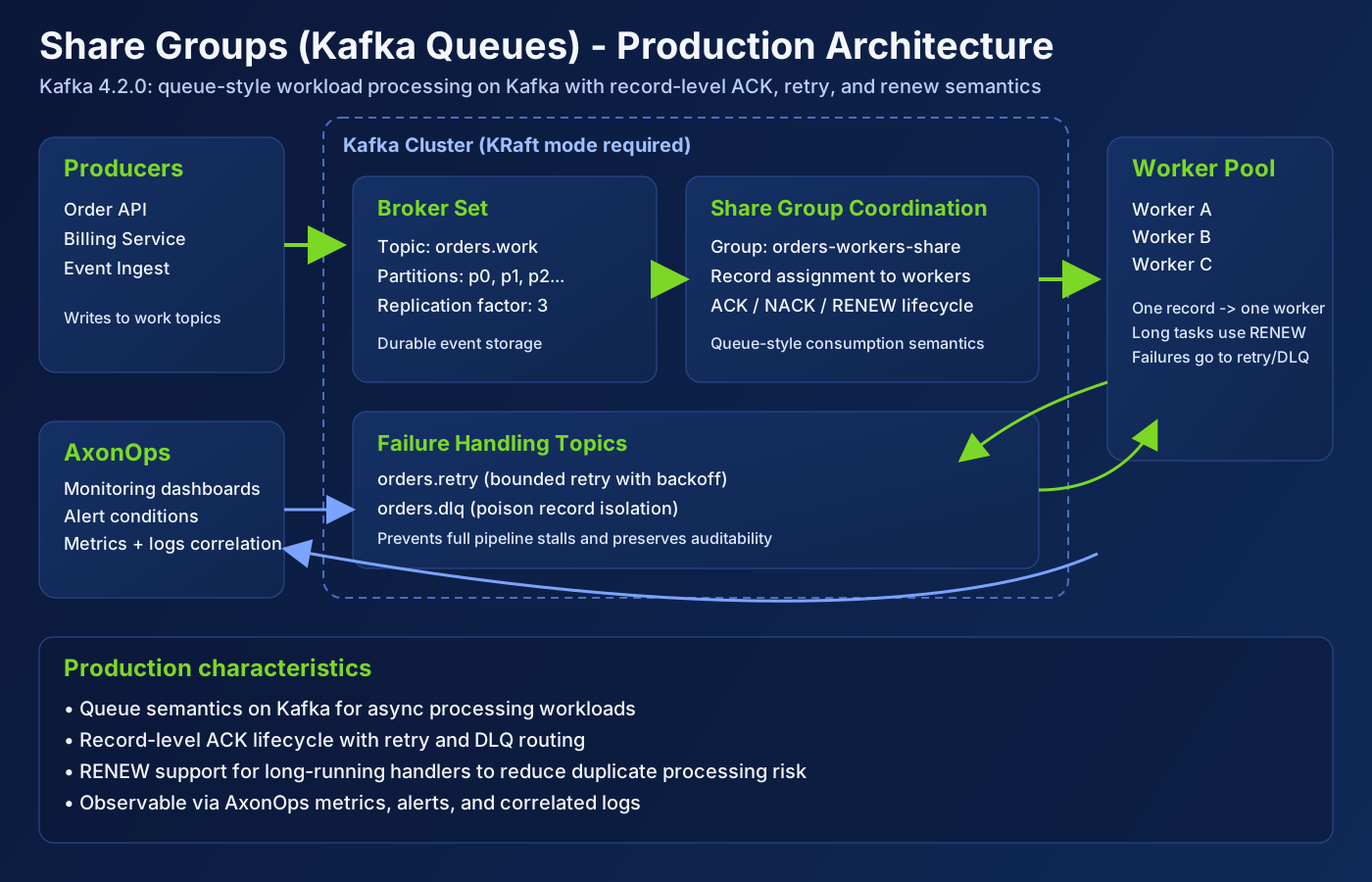
Kafka has traditionally been strongest for log and stream processing, where ordered partition consumption is central to the design. Share Groups extend that model so teams can also run queue-style workloads without introducing a second messaging system for the same data domain.
In practical terms, Share Groups are useful when each record should be handled by one worker from a group, with explicit acknowledgement and retry behavior at record level. This suits use cases such as async job execution, enrichment pipelines, and background operational tasks where strict partition-order replay is less important than controlled work distribution and retry safety. The RENEW acknowledgement path in 4.2.0 is particularly useful for longer-running handlers because it reduces false timeout and duplicate-processing scenarios while work is still in progress.
2. Kafka Streams is stronger in production
Kafka Streams also receives meaningful hardening in this release. The server-side Streams rebalance protocol reaches GA with a limited feature set, dead letter queue (DLQ) handling is introduced for exception paths, and scheduling behavior improves with anchored wall-clock punctuation. Shutdown behavior is also more predictable through better leave-group control.
Taken together, these changes make Streams applications easier to operate under real pressure. When a topology encounters malformed input or transient downstream failures, operators have clearer controls and cleaner recovery options instead of relying on ad hoc workarounds.
3. Observability and metrics are more coherent
Kafka 4.2.0 improves observability in ways that matter during incidents. Metric naming is more consistent around the kafka.COMPONENT pattern, new idle-ratio metrics improve visibility into controller and MetadataLoader behavior, and Share Groups gain additional lag metrics.
This helps platform teams build cleaner dashboards and shorten diagnosis time. Instead of debating whether a symptom originates in consumer lag, control-plane pressure, or background metadata activity, operators can move more quickly from signal to action.
# AxonOps alert conditions (PromQL examples)
# 1) Controller pressure sustained for 10m
avg_over_time(kafka_controller_idle_ratio[10m]) < 0.20

# 2) Share Group lag remains above threshold for 10m
max_over_time(kafka_share_group_lag[10m]) > 50000

# 3) p95 request latency breach
histogram_quantile(0.95, sum(rate(kafka_network_request_latency_seconds_bucket[5m])) by (le, cluster)) > 0.250
# AxonOps dashboard query examples (PromQL)
# 1) Cluster-wide controller pressure snapshot
avg(kafka_controller_idle_ratio) by (cluster)
# 2) Top lagging Share Groups
topk(10, max(kafka_share_group_lag) by (cluster, group))
# 3) Correlate controller pressure with request latency
histogram_quantile(0.95, sum(rate(kafka_network_request_latency_seconds_bucket[5m])) by (le, cluster))4. CLI behavior is becoming more consistent
Kafka tooling continues to standardize command arguments, with broader use of flags such as --bootstrap-server and --command-config. Several older options are now deprecated as Kafka moves toward 5.0.
For operations teams managing scripts, automation jobs, and runbooks across multiple clusters, this is a practical improvement. Standardized CLI patterns reduce avoidable mistakes and make operational tooling easier to maintain over time.
# Before vs now: one consistent pattern across admin commands

# Older style (mixed patterns, harder to standardize in scripts)
kafka-topics.sh --zookeeper zk-1:2181 --list
kafka-consumer-groups.sh --zookeeper zk-1:2181 --describe --group orders-workers-share

# Current style (Kafka 4.x direction): --bootstrap-server + --command-config
kafka-topics.sh --bootstrap-server broker-1:9092 --command-config /etc/kafka/admin.properties --list
kafka-consumer-groups.sh --bootstrap-server broker-1:9092 --command-config /etc/kafka/admin.properties --describe --group orders-workers-share
kafka-configs.sh --bootstrap-server broker-1:9092 --command-config /etc/kafka/admin.properties --entity-type topics --entity-name orders.work --describe

# Same style for create/update operations
kafka-topics.sh \
  --bootstrap-server broker-1:9092 \
  --command-config /etc/kafka/admin.properties \
  --create \
  --topic orders.retry \
  --partitions 12 \
  --replication-factor 3
5. Security and correctness are further tightened
Kafka 4.2.0 includes additional hardening, including a new allowlist-based connector client config override policy, thread-safety improvements in RecordHeader, and clearer validation and deprecation behavior around configuration.
In production, these changes usually show up as fewer edge-case surprises: safer multithreaded behavior, better guardrails in shared environments, and clearer signals when configuration drift introduces risk.
What this means for platform teams
Kafka 4.2.0 is primarily an operations-focused release. It strengthens the areas that drive production stability, including queue-style workload support through Share Groups, more robust Streams behavior, clearer observability signals, and more consistent CLI usage in scripts and runbooks.
Practical implementation notes for engineering teams
Moving to Kafka 4.2.0 successfully is less about changing everything at once and more about tuning client behavior deliberately. In most production estates, the first gains come from validating consumer stability under rebalance pressure and ensuring producer latency does not drift during broker rollout windows.
For Java consumers, start with explicit polling, heartbeat, and commit settings so the application behavior is predictable during failover events and Share Group testing:
# Consumer baseline for production workloads
bootstrap.servers=broker-1:9092,broker-2:9092,broker-3:9092
group.id=orders-processing-v2
enable.auto.commit=false
auto.offset.reset=latest
session.timeout.ms=45000
heartbeat.interval.ms=3000
max.poll.interval.ms=300000
fetch.min.bytes=1
fetch.max.wait.ms=500
For producers, the safest default pattern in operationally sensitive systems remains idempotent writes with bounded in-flight requests and explicit delivery timeouts:
# Producer baseline for durable delivery
bootstrap.servers=broker-1:9092,broker-2:9092,broker-3:9092
acks=all
enable.idempotence=true
max.in.flight.requests.per.connection=5
retries=2147483647
delivery.timeout.ms=120000
request.timeout.ms=30000
linger.ms=20
compression.type=zstd
For Kafka Streams, 4.2.0 gives stronger operational behavior when you combine controlled shutdown semantics with DLQ handling in the topology. A practical baseline looks like this:
application.id=fraud-detection-streams
bootstrap.servers=broker-1:9092,broker-2:9092,broker-3:9092
processing.guarantee=exactly_once_v2
num.stream.threads=4
replication.factor=3
state.dir=/var/lib/kafka-streams
commit.interval.ms=1000
And in code, route poison records to a dedicated dead-letter topic instead of failing the whole topology:
StreamsBuilder builder = new StreamsBuilder();
KStream<String, PaymentEvent> input = builder.stream("payments.incoming");

KStream<String, PaymentEvent>[] branches = input.branch(
  (k, v) -> isValid(v),
  (k, v) -> true
);

branches[0].to("payments.validated");
branches[1].mapValues(v -> serializeErrorEnvelope(v)).to("payments.dlq");
Rollout blueprint
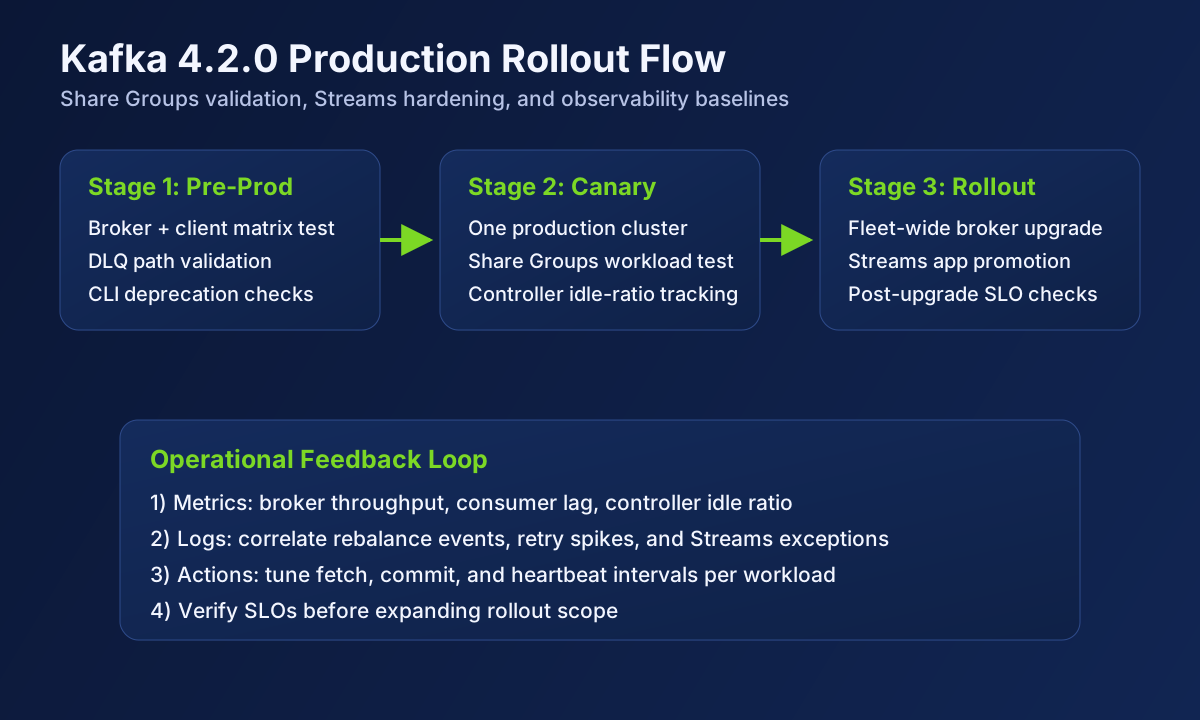
The safest deployment pattern is staged: validate in pre-production, canary on a single production cluster, and then promote broadly only after metric and log baselines remain healthy.
Upgrade planning notes
Before rollout, it is worth spending time on script compatibility and failure-path testing. Teams should review deprecated flags in existing automation, validate command usage in CI/CD jobs, and run controlled Streams failure tests with DLQ behavior enabled. If queue-like processing is important in your architecture, evaluate Share Groups under realistic concurrency and retry conditions rather than only synthetic benchmarks. Kafka’s official 4.2.0 upgrade notes remain the right source of truth for compatibility details.
Summary
Kafka 4.2.0 focuses on parts of the platform that affect daily operations, including consumer stability under load, Streams failure handling, clearer operational metrics, and more consistent CLI behavior in automation and runbooks. For teams running several clusters, those changes are practical rather than cosmetic because they reduce avoidable incidents and make troubleshooting faster.
Share Groups reaching production readiness is the largest platform-level addition in this release, as it lets teams handle queue-style processing directly in Kafka instead of splitting workflows across multiple messaging systems. Alongside that, the Streams and observability improvements make failure recovery less manual and easier to standardize.
If you are already on Kafka 4.x, the sensible rollout path is to complete compatibility checks, run a canary in production, and validate your retry and DLQ behavior before broad promotion. With that approach, most teams should see steadier operations and shorter incident resolution times after upgrade.